
The Importance of Quality
Defining Quality in Investing: Explore how TimesSquare integrates quality in our investment approach.
Throughout our daily lives, we consider many variables when making decisions or purchases. All things being equal, there is a distinct preference for quality. Quality refers to the overall excellence of something, often in comparison to a standard or expectation. The benefits of quality extend far beyond good products or services. Customers who consistently receive high-quality products or services are more likely to be satisfied, returning for more. Similarly, companies known for quality products or services build strong reputations that attract customers and investors. They also typically command a pricing premium for their offerings. When employees know they're producing high-quality work, it can boost their morale. By combining satisfied customers, efficient operations, and a strong reputation, companies focused on quality are well-positioned for long-term success.
Quality Investing
Quality businesses possess traits such as competent management, strong financials, stability, and profitability. While revenues, earnings, debt levels, and cash flows are measurable, other considerations are more subjective. For example, a competent and experienced management team is crucial to a company’s long-term success. Quality investing is a long-term investment strategy, which has demonstrated success in a variety of market environments. In bear markets, quality companies often exhibit lower stock price volatility, thereby providing protection for investors during downturns. In bull markets, these businesses are positioned to capitalize on economic growth. Profitable companies possess the wherewithal to reinvest in their businesses and enhance their competitive position. This can be used to protect existing revenue streams or innovate goods and services for future growth.
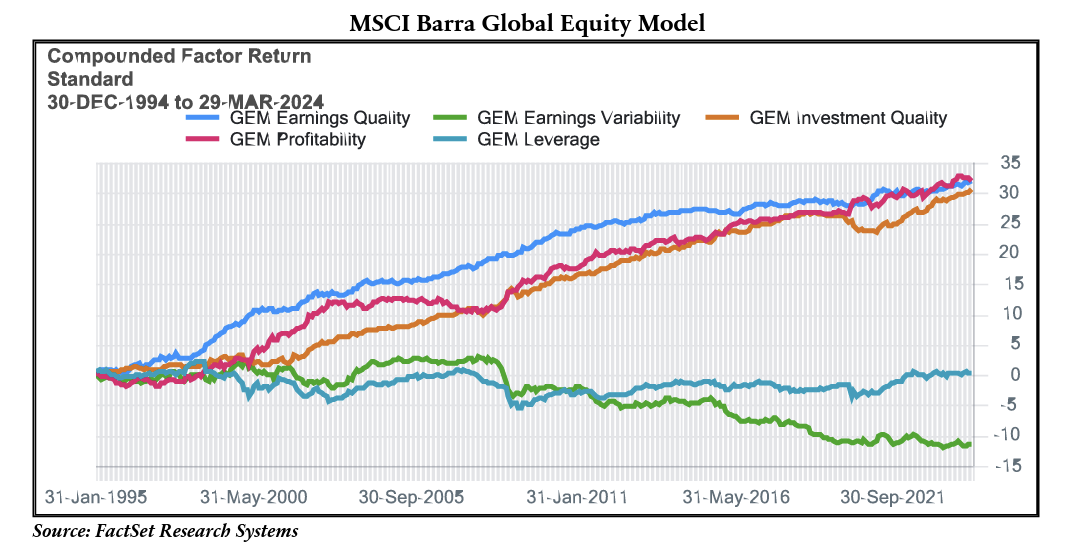
From this Barra Risk analysis there are some noteworthy takeaways:
Higher quality companies, which have lower levels of uncertainty related to their business fundamentals, are able to outperform the market over the long run, operate efficiently, and are profitable. These types of companies are less inclined to go on buying sprees for which they would be issuing secondary equity deals that would be dilutive to investors and have lower levels of debt on their balance sheets.
TimesSquare’s Search for Quality
Over the years, we have found that quality businesses are grounded by strong management teams. One of the hallmarks of our investment approach is the assessment of company management. We evaluate them on the merits of their integrity, decisionmaking, alignment of interest with shareholders, stewardship of capital, knowledge & sensitivity to their business risks, and vision for the future. Once we gain this level of confidence, we evaluate the company to determine if it possesses sustainable and competitive advantages. This could be in the form of a unique product, patent, service, manufacturing capabilities, structural or regulatory barrier to entry. Our Research Analysts build proprietary financial models to understand the true growth drivers of a business. This work is also used to assess profitability, financial strength, future cash flows, and ultimately, the fair value of each company. Collectively, the results in our assessment of an investment’s quality.
Given TimesSquare’s niche focus on finding quality growth businesses in the small to mid-capitalization universe, we would like to share a few examples that highlight some of the quality elements we are seeking.
Stock Example #1: Casella Waste Systems provides a recession-resistant essential service with consistent pricing driving doubledigit organic free cash flow growth. The oligopolistic disposal landscape keeps unit pricing rational while a fragmented collection market presents an attractive opportunity to deepen vertical integration via M&A.
Casella Waste Systems, Inc. (CWST)
An integrated provider of waste collection. disposal and recycling services focused on the Northeast and MidAtlantic U.S. marketplace. The company has been an active consolidator of the highly-fragmented waste collection landscape within and adjacent to its geographic footprint over the past 50 years. CWST’s growth strategy has significantly enhanced route density, operational scale, pricing power and profitability over last several years.
Qualitative assessment
- Return-focused management team has shown strong capital stewardship.
- Growing scarcity of disposal capacity in Northeastern U.S. widens existing competitive moat and enhances pricing power.
- Relative to peers, CWST’s earnings are much less vulnerable to recycled commodity price fluctuations as the company’s contracts offload commodity risk to municipal customers.
Fundamental analysis
- Consistent price-led double digit free cash flow and share growth.
- 40% excess disposal capacity in a capacity constrained market presents a long-term source of revenue and operating margin upside.
Stock Example #2: O’Reilly Automotive possesses a price-inelastic, recession-resilient, all-weather business whose demand is driven by the age of vehicles and road conditions. Inflation tailwinds, given their long history of industry pricing power driving sales and maintaining high margins.
O’Reilly Automotive (ORLY)
A specialty retailer of automotive aftermarket parts, tools, supplies, equipment and accessories with over 6,000 stores across 47 US states as well as 48 stores in Mexico. ORLY carries an extensive product line of hard parts, maintenance items, accessories, paint and professional service equipment for both do-it-yourself (DIY) customers (50%) and commercial installers (50%).
Qualitative assessment
- Execution-oriented, best in class parts warehouse network and logistics capabilities that drive industry leading service and rapid delivery times to their commercial customers.
- Steadily captures market share through superior execution while competitors have faltered.
- Return-focused management team that are good stewards of capital.
Fundamental analysis
- High returns on invested capital of 20%+ over the past 10 years.
- Steadily expanding margins.
Stock Example #3: Nippon Gas’ market position supports pricing power in an inflationary environment. The greater Tokyo market is highly fragmented with 4,500 distributors. Nippon Gas also has a unique ability to bundle gas and electricity at lower costs than peers. The company is extending their offering to include solar power and hybrid water heaters. In addition, new regulations for limiting truck driver working hours are likely to rapidly consolidate the market by pushing out inefficient competitors.
Nippon Gas (8174-TKS)
One of the largest retail liquefied petroleum gas (LPG) suppliers in Japan. The company was established in 1955 and started its LPG business in the Kanto region. In 1966, it established Shinnihon Gas Corporation and started its city gas business. Nippon Gas entered the city gas market in 1966 and listed in 1973. In 2017, it established a joint city gas platform and a strategic alliance with TEPCO. In November 2018, it started retail electric power sales through a discount electric and gas bundle..
Qualitative assessment
- Smart meters and IT implementation support high margins; Nippon Gas’ per-kilogram cost of filling and delivery is less than half vs. their competition.
- Nippon Gas’ large scale LNG hub allows more efficient transportation and delivery.
- Management has a proactive stance on shareholder returns.
- Nippon Gas’ market position supports pricing power in an inflationary environment.
Fundamental analysis
- Best in class asset and capital efficiency.
- Growing the business at twice the rate of the market.
Macroeconomic Environment
According to the International Monetary Fund, the baseline forecast for the world economy is a continuation of the 3.2% growth rate experienced in 2023 and projected to be at the same rate in 2024 and 2025. Global inflation is forecast to decline steadily from 6.8% in 2023 to 5.9% in 2024 and 4.5% in 2025. Central banks are navigating a difficult balancing act between controlling inflation and preventing a recession. Investors and businesses are cautious with the backdrop of uncertainty caused by slowing growth and persistent inflation.
All three stock examples are businesses with demonstrated histories of riding through a variety of macroeconomic conditions.
Conclusion
Investment styles and asset classes may come in and out of favor during market cycles due to macroeconomic changes or investment sentiment. However, quality businesses have the wherewithal to outperform during down-market periods due to their enduring nature, thereby benefiting investors who may be allocated to riskier asset classes in addition to a quality strategy. As such, we believe a quality investing approach can both stabilize and add to returns over longer-term time horizons.
As bottom-up investors with an emphasis on quality, we seek the underpinnings for near-term valuations in the form of expected earnings growth and other business fundamentals. We continuously review the business models and management teams of current and potential holdings. With over 23 years of investment history as a quality growth manager, we believe this approach to investing will continue to provide a competitive edge for not only weathering complex storms but navigating market cycles.
TimesSquare Capital Management LLC is a growth equity specialist that is registered as an investment adviser with the U.S. Securities and Exchange Commission and is majority owned by Affiliated Managers Group, Inc. With an experienced investment team and rigorous fundamental analysis, we identify high quality companies with strong management in inefficient market cap ranges. As a boutique, our highly collaborative process and integrated approach promote our commitment to meeting our clients’ service needs. Importantly, employees share a common economic interest through equity participation aligning them with the success of our clients and the firm.
This material is for your private information and is provided for educational purposes only. The views expressed are the views of TimesSquare Capital Management, LLC only through the period ended May 2024 and are subject to change based on market and other conditions. The opinions expressed may differ from those with different investment philosophies. The information we provide does not constitute investment advice and it should not be relied on as such. It should not be considered an offer or solicitation to buy or an offer to sell a security. It does not consider any investor’s particular investment objectives, strategies, tax status or investment horizon. We encourage you to consult your tax or financial advisor. All material has been obtained from sources believed to be reliable, but its accuracy is not guaranteed. There is no representation or warranty as to the current accuracy of, nor liability for, decisions based on such information.
TimesSquare Capital Management, LLC
75 Rockefeller Plaza, 30th Floor, New York, NY 10019
©Copyright 2024 TimesSquare Capital Management, LLC. All rights reserved.
This document may not be reproduced, in whole or in part, without permission of the author.
(Blue%20%26%20Gold)(Transparent)(2125x844)%20PNG.png)