
Interview with Sonu Chawla, CFA: The Wall Street Transcript
DOWNLOAD THE PDFIn this Wall Street Transcript interview, TimesSquare Portfolio Manager Sonu Chawla, CFA, breaks down her high-conviction mid-cap holdings — including Snowflake, Curtiss-Wright, Carpenter Technology, and Interactive Brokers — and explains why mid-caps remain an alpha-rich hunting ground in the AI era.
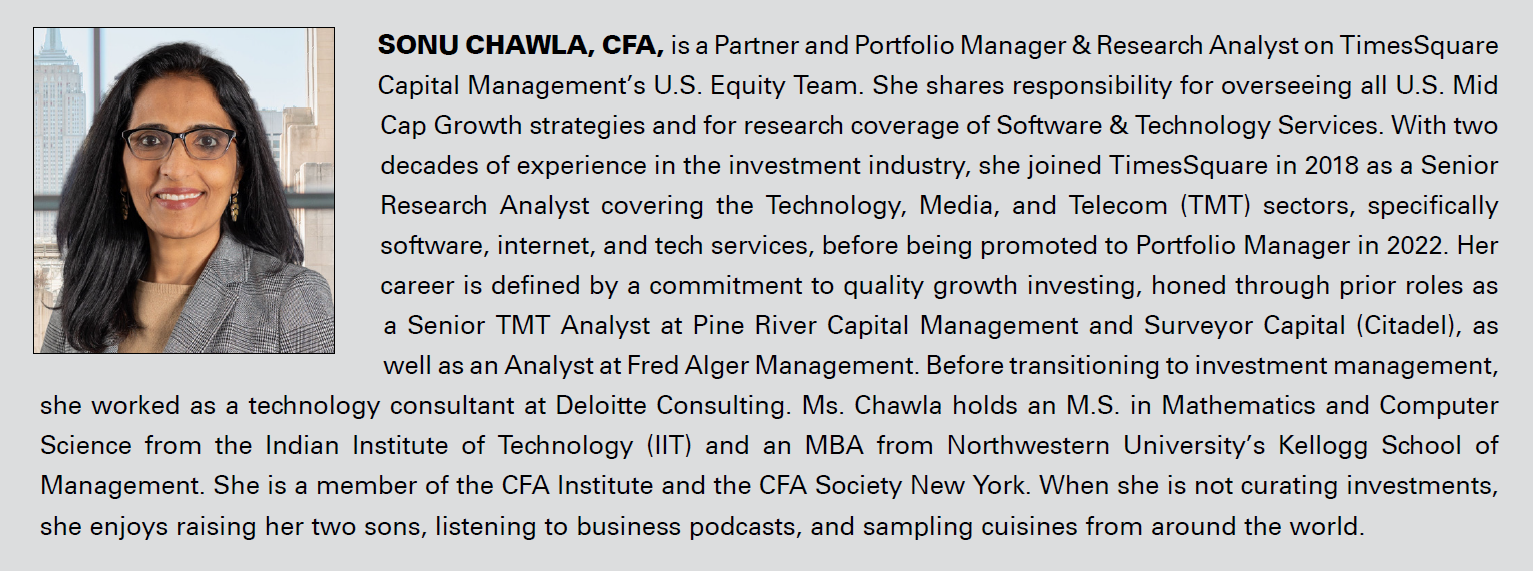
TWST: To start things off, could you tell us about your role at TimesSquare Capital Management and how you got into the finance industry?
Ms. Chawla: So, I am a portfolio manager on the U.S. Mid Cap Growth equity strategy at TimesSquare. We offer the mid-cap portfolio in three different flavors: a very concentrated 15- to 20-stock focus strategy, a semi-concentrated 30- to 40-stock ETF that we launched about six months ago (NASDAQ:TSCM), and then the mid-cap diversified strategy, which is 70 to 80 stocks.
I'm a portfolio manager on all those three flavors of the mid-cap product, as well as I wear dual hats with analyst responsibilities covering parts of the tech sector.
TWST: Further to that analyst role, I understand that before you specialized in investing, you were working more on the business side of things.
Ms. Chawla: Yes. Just to give a little bit more background on myself, I have a Master of Science degree in Mathematics and Computer Science from Indian Institute of Technology. Then I went into technology consulting with one of the big five firms, Deloitte Consulting.
The Deloitte experience was great, as it provided me with a unique under-the-hood perspective on how different companies work across various sectors, how they scale, their operational strategies, and the strategic decision-making undertaken by management teams.
I loved the analytical parts of the job, and I wanted to pivot from being a consultant to being an investor where I could apply the same analytical rigor to capital allocation and investing. So I decided to go to Kellogg School of Management, Northwestern University, to pursue my MBA. I also got a CFA so that I could transition into investment management with some background in finance and accounting. That's my journey into investments.
TWST: TimesSquare specializes in mid-cap investments, so before we get into specifically what sort of securities you're looking for to fill your portfolios, what is your definition of mid-cap at the moment?
Ms. Chawla: Yes, just to be clear TimesSquare specializes in small- and mid-cap investing. The definition of mid-cap investing actually evolves every year because we are benchmarked to the Russell Midcap Growth Index which, as we know, reconstitutes every year in June.
Starting this year, the Russell Indices will be reconstituting twice after several years where names in the Russell Small Cap Growth Index and Russell Midcap Growth Index have become outsized allocations. A good example of this was Palantir in 2025, when its market cap grew north of $300 billion and had a weighting in the index greater than 8%. Starting in 2026, the indices will rebalance in June and December. This is the first year that will go into effect.
Currently, based on this June's reconstitution, our threshold for mid-cap is around $2 billion to $66 billion in market cap ranges. So anything in that market-cap range is fair game for initiating a new position in the portfolio.
I also want to caveat that if there is a benchmark name that is outside of those market cap thresholds, that is fair game for our strategy to own as well. So, if there is a $90-billion market-cap company in the index, we can initiate a position in that name. But that market cap range has evolved from a decade ago, when it used to be much lower market-cap ranges as the definition of mid-cap.
TWST: Even a couple of years ago, I remember talking to other small- and mid-cap investors who were looking at a high-end capitalization of, say, $14 billion or so.
Ms. Chawla: Oh, 100%. Yes.
TWST: So with that in mind, given your emphasis on mid-cap investments, who do you see as the investors or potential investors in your recently launched TSCM ETF versus your other mid-cap strategies?
Ms. Chawla: Yeah, that's a great question. We launched the TimesSquare Quality Mid Cap Growth ETF — TSCM — in December 2025. We consider TSCM a cousin strategy because it's a concentrated portfolio of 30 to 40 holdings, with the diversified U.S. Mid Cap Growth strategy being 70 to 80 stocks, as previously mentioned.
"The last thing I would point out is that this strategy also comes with an attractive fee of 55 basis points, which is competitively priced. We believe the ETF draws from the same rigorous investment process that has driven TimesSquare's institutional investment process over the last two and a half decades."
That is sort of the fishing pond for the ETF. We are using those 70 to 80 names that we own in the diversified strategy as that fundamentally vetted, investable universe to own in the ETF.
One of the main reasons we chose to launch an ETF was that throughout our ETF exploration journey, our partners in the RIA and wealth community wanted to access a strategy in a more tax-efficient and more widely distributed vehicle. Given our historical success in both our diversified and focus growth strategies, we were confident in our ability to offer this product.
%20Screenshot%202026-08-18%20153033.png)
The last thing I would point out is that this strategy also comes with an attractive fee of 55 basis points, which is competitively priced. We believe the ETF draws from the same rigorous investment process that has driven TimesSquare's institutional investment process over the last two and a half decades.
TWST: How has the TSCM ETF performed versus the general market and versus your benchmark in 2026 so far?
Ms. Chawla: The product launched December 2025. In terms of the performance year-to-date as of June 30, 2026 we are ahead of the Russell Midcap Growth Index¹, which is definitely a good start. Hopefully, we can build on that over a longer period of time, but we're off to a solid start.
TWST: For the last 10 years or maybe even more, the vast bulk of market attention has been paid to the most mega-cap, household-name-type tech companies, and then transitioned into the AI narrative. Given there was so much focus on these mega-cap AI and tech-related names, have there been similar gains among mid-cap companies in that same space?
Ms. Chawla: Oh, 100%. We think mid-cap is an alpha-rich, great hunting ground for companies that are inflecting in their growth profile.
Even in the AI ecosystem, the picks and shovels of the whole AI infrastructure build-out, there are plenty of names to fish across different sectors. It's not just a TMT — Technology, Media, and Telecom — phenomenon; it impacts industrials, it impacts energy, and materials sectors as well. So, we've been very active looking for those names.
Just a plug for mid-cap in general: Obviously, we have a bit of a biased opinion just because we have been mid-cap specialists — we think of them as a happy medium between large and small.
If you were to go back in time over the last 25 years, mid caps have returned approximately 9%, outperforming both large caps, which have been up 8%, and small caps, which is a smidge below 8%, with less risk than the small-cap brethren. On a rolling five-year basis, mid-caps outperform large caps nearly 60% of the time by around 400 basis points, and outperform small caps 90%-plus of the time by around 200 basis points.
We think that historically they've offered a compelling risk-adjusted return profile. Within the AI ecosystem, we've been plenty active, across TMT, across industrials, and across energy materials.
TWST: Is there a company tied to AI — or that has benefited greatly from the AI tech, automation, and updating of technology narrative — that you might like to highlight? Perhaps you can also use that as an opportunity to detail the qualities that you look for in a TimesSquare investment and why a company might fit into your TSCM ETF in particular.
Ms. Chawla: Yes. Within TMT, the AI picks and shovel winners have been mostly in the semiconductors and the hardware spaces. Interestingly, software is the area that has lagged on the perception that AI is not going to be beneficial for the software ecosystem.
Earlier in the year, while there was no nuance to software investing — i.e., the whole space was trading as one big basket — we started to see areas of opportunity in that drawdown. In particular, we zeroed in on the name of a company called Snowflake (NYSE: SNOW).
Snowflake is an IT infrastructure software company whose cloud data platform lets organizations store, analyze, and share massive datasets at scale on a consumption-based model, where more than 95% of revenue actually comes from usage — the data usage of their platform.
We think of Snowflake as a core "get your data in order for AI" sort of a winner, because we all know that AI applications are only as good as the data behind them. Before enterprises can deploy AI at scale, they have to consolidate, clean, and govern their data on a modern cloud platform. So Snowflake sits right at the center of that ecosystem.
The core of the thesis is that AI differentiation comes from data, not models; the moat is the data. The data sits in Snowflake, and you can bring AI to the data, running inference within Snowflake's platform parameters closest to where the data already lives in a secure and governed fashion.
So that's the Snowflake investment thesis in a nutshell.
To give you background on how we did the work and started building the position, we began building a Snowflake position in the fall of 2025 and meaningfully increased it in April and May of 2026, this year, on a broad-based pullback in software stocks.
We nearly doubled our position this spring as our due diligence bolstered our conviction. The process that I'll lay out is a good window into how we work.
"Our throughline into that position is that Snowflake is positioning itself as the center of data gravity and the emerging agent control plane at the intersection of enterprise data, application connectivity, and model independence. That's why it is a high-conviction name that we feel good about going forward as well."
We've said we are fundamental, bottom-up stock investors, and when we are doing the due diligence, it involves a lot of qualitative input where we go out and talk to not only the company management and meet them in their offices or at conferences and attend their user conferences, but also talk to the whole ecosystem around them, which is customers, partners, and competitors.
.png)
To give you insight into how we went about that process for Snowflake, we attended Snowflake's regional customer conference in New York last fall. We spent two days at Snowflake's large annual customer summit in San Francisco this spring, which brought together their customers, partners, and management, and we held a series of expert calls. This is the kind of primary, on-the-ground work that builds a 360-degree view.
What we heard confirmed an accelerating wave of cloud migrations, particularly in financial services, with integration partners and system integrators — consultants — predicting strong activity that they were seeing on the ground, as well as the pipeline that was building into 2027 as legacy Teradata (NYSE: TDC) and Oracle (NYSE: ORCL) systems are being migrated over to the Snowflake environment.
The customer spend is sizable and compounding. We heard one large bank's Snowflake data footprint grew roughly 200% year-over-year, with query volumes up about 4x. Multiple regulated industries are rapidly scaling spend.
Early adopters increased their Snowflake consumption by an average of about 11%. That's a two-pronged tailwind of faster migrations plus more consumption, and it wasn't in the company's guidance that they laid out at the start of the year.
That thesis then showed up in their earnings results that they just put up at the end of May when they reported results. Their growth rate accelerated to mid-30% range, re-accelerating from 30% in the prior quarter, and it was their strongest sequential dollar growth in company history, alongside very strong new customer logo adds and 300-plus basis points of operating margin expansion.
Our throughline into that position is that Snowflake is positioning itself as the center of data gravity and the emerging agent control plane at the intersection of enterprise data, application connectivity, and model independence. That's why it is a high-conviction name that we feel good about going forward as well.
TWST: Is Snowflake solely a position within the TSCM ETF, or is it also part of TimeSquare's other strategies?
Ms. Chawla: It is owned across all three flavors of our mid-cap strategies: the diversified mid-cap growth, the ETF and the more concentrated focused strategy.
TWST: I read that TimesSquare itself uses AI quite substantially. Could you tell us a bit about that? Like most, I'm sure you've run into both pleasant surprises and less-pleasant surprises in your use of AI. Given your own tech background, I'm curious about your thoughts on how AI has helped improve your business operations in whatever manner, the nascent challenges you see coming up from its use, and what you might be anticipating as the next steps in AI development, particularly for business users.
Ms. Chawla: Yes, that's a great question. I think we are all, within enterprises — and I do talk to other businesses as well as part of my due diligence around stocks — we are still in inning one of AI adoption. I think we're all learning at the same time as to the best practices, how to implement it, and how to get the most use out of it.
You've likely heard the phrase "token-maxxing," all the rage in wintertime at the start of this year. Now we've quickly pivoted to talking about how we can get more efficient with the use of that technology. Obviously, we've heard about open-weight models gaining a foothold in enterprises.
Generally speaking, I do think that increasing competition at the model layer should be good for broader AI diffusion or AI adoption within enterprises, if it comes with lower costs and the ability for companies to customize it to their needs in a secure, governed fashion.
As you may have heard, there was a letter posted by Nvidia CEO Jensen Huang, as well as with other CEOs like Microsoft's Satya Nadella and other big mega-cap tech CEOs, who joined in blessing the viewpoint that open-weight models are an important part of that foundation because they make advanced AI more accessible, adaptable, and widely available.
"What is beautiful about the Curtiss-Wright business is that it has very long-term visibility, meaning they have backlogs going out to the mid-2030s. It has been a fantastic execution machine. We also think really highly of the management team. They've been great capital allocators."
So I think that's a good development in general. More choice on the model layer benefits and probably accelerates the AI diffusion within enterprises.
As for our use of AI, we started using it this spring through a subscription to Anthropic's Claude models, but we've also been leveraging AI across the platforms we already subscribe to via Model Context Protocol (MCP) connectors. We do subscribe to Claude's models internally for our research team, which has honestly been a big productivity boost for the team.
How it helps is that it acts as your AI helper for support during earnings season. Earnings season can get very crowded, with earnings events all stacked on top of each other. It helps you keep up with all the data flow that's happening around earnings events. You can digest more earnings transcripts so that you can understand what the read-throughs are for the names that you hold in the portfolio.
It also helps with preparing due diligence reports on a new name where it can go through data more quickly. AI is as good as the data you're feeding it, but it helps you sift through the data that you feed it, which helps to speed up the due diligence process. It basically does the grunt work in a more efficient manner.
Obviously, judgment is something that you cannot outsource to AI. As I mentioned earlier, in-person due diligence meetings, like the Snowflake one referenced earlier, all happen in person. That part you can't outsource to the AI. But in terms of just the basic blocking and tackling, think of the repetitive work that needs to be done, maybe even helping update models or building models from scratch if you feed it the historical financial data — all those are great use cases of AI.
Personally, that's how I'm leveraging AI, but it's exciting. It's exciting as these models improve. I'm excited to see what's the future potential for these models as well.
TWST: Let's move on to a couple of other themes your website notes as being quite high-conviction for you at TimesSquare, which are aerospace and defense and also specialized financials. Could you give us a name from each that helps to illustrate where you feel the opportunities are?
Ms. Chawla: Yeah, aerospace and defense have been a very vibrant and a dynamic source of alpha for us. I can highlight a couple of names that we own in that area.
We own a name called Curtiss-Wright (NYSE: CW). It's one of our top-10 positions. Curtiss-Wright provides engineered product solutions and services mainly to aerospace, defense, believe it or not, commercial nuclear power, and lastly industrial markets.
They've done a fantastic job. They dominate within defense markets. They are the dominant supplier to the U.S. Navy's Virginia-class submarines. They've used that nuclear know-how on the defense side to stand up a civilian nuclear business. For the Westinghouse AP1000 nuclear reactors, Curtiss-Wright provides nearly $150 million in content for each unit.
As you hear about various countries around the globe standing up more nuclear plants and installing Westinghouse AP1000 nuclear reactors, Curtiss-Wright's civilian nuclear business, which is small, is scaling really, really fast.
What is beautiful about the Curtiss-Wright business is that it has very long-term visibility, meaning they have backlogs going out to the mid-2030s. It has been a fantastic execution machine. We also think really highly of the management team. They've been great capital allocators. So that's one of the names that has done well, and for us, we continue to have great conviction in that name.
.png)
Obviously, as prudent asset managers we can monetize some of the gains when the stock goes on a run and nears our price targets, but it is one of the steady-eddie compounders that we think of.
The other name that we hold in the aerospace and defense side is Carpenter Technology (NYSE: CRS). It manufactures, fabricates, and distributes specialty metallurgical alloys. Two-thirds of their end market is aerospace and defense, but their alloys are also used in the wind and gas turbine blades that are manufactured by GE Vernova. They have diversified end markets, but the biggest one is aerospace and defense.
As aerospace volumes are ramping back up for Boeing and Airbus, Carpenter benefits not only on the volume side, but pricing is a great lever because it's a very consolidated end market with high barriers to entry. Standing up a new plant can take approximately 10 years.
These are the type of quality growth businesses with sustainable competitive advantages that TimesSquare likes to invest in. We initially invested in Carpenter when it was seriously undervalued relative to its peers. It was trading at roughly half the multiple of someone like Howmet. More recently, that valuation multiple has closed as the stock has re-rated, so we've taken some profits in Carpenter. But those are some of the examples of names we hold in aerospace and defense.
To your question about specialized finance, Interactive Brokers (NASDAQ: IBKR) is a name that we hold in the specialized finance area. Its platform facilitates execution, clearance, and settlement of trades in stocks, bonds, options, and a host of other financial instruments. They're also entering the prediction markets, more on the financial contracts, not sports betting.
They continue to do really, really well. This is one of the more underappreciated names. They have had very strong customer account growth, north of 30%. They're gaining market share in the international markets; international traders who want to access the U.S. or want to invest in the U.S., they provide very competitive rates, which is why they've been gaining market share over the competitive set.
They've done all that while expanding margins, so it's a good combination of top-line growth, with margin expansion north of 70% EBITDA margins, while trading at a discount to peers like Robinhood. So that's a name that we like in specialized finance.
TWST: What is your general thesis on specialized financials? Why are you interested in that theme?
Ms. Chawla: We tend to be very picky in the names that we invest in across sectors. In financials, we tend to stay away from anything that is balance-sheet heavy, where there can be credit risk. We tend to stay away from certain pockets of financials, and that means that our focus tends to be in specialized insurers, specialized financials like Interactive Brokers, alternative asset managers, or boutique capital markets-levered plays like an Evercore (NYSE: EVR) or commercial real estate brokers like a CBRE (NYSE: CBRE). Those are the areas that we tend to focus on within financials.
TWST: I see. Are you drawn to niche applications particularly because of, I guess, their "nicheness"?
Ms. Chawla: Yes. Those are undiscovered areas that are trafficked less, and there is less risk from a business standpoint when credit sensitivity to balance-sheet financials is low. From a quality standpoint, we tend to think of these specialized financials as higher quality. That's sort of our quality bias, really, more than anything else.
TWST: Thank you. (RP)
1 Performance data quoted represents past performance; past performance does not guarantee future results. The investment return and principal value of an investment will fluctuate so that an investor's shares, when redeemed, may be worth more or less than their original cost. Current performance of the fund may be lower or higher than the performance quoted. Performance data current to the most recent month end may be obtained by calling 888-ETF-TSCM /or visiting here.
Specific investments described herein do not represent all investment decisions made by the Firm. The reader should not assume that investment decisions identified and discussed were or will be profitable. Specific investment advice references provided herein are for illustrative purposes only and are not necessarily representative of investments that will be made in the future.
This document does not constitute advice or a recommendation or offer to sell or a solicitation to deal in any security or financial product. It is provided for information purposes only and on the understanding that the recipient has sufficient knowledge and experience to be able to understand and make their own evaluation of the proposals and services described herein; any risks associated therewith; and any related legal, tax, accounting or other material considerations. To the extent that the reader has any questions regarding the applicability of any specific issue discussed above to their specific portfolio or situation, prospective investors are encouraged to contact TimesSquare Capital Management, LLC and/or consult with the professional adviser of their choosing.
Investors should consider the investment objectives, risks, charges and expenses carefully before investing. For a prospectus or summary prospectus with this and other information about the Fund, please call (888) ETF-TSCM. Read the prospectus or summary prospectus carefully before investing.
Investing involves risk. Principal loss is possible.
For the TimesSquare Glossary please visit here. For information regarding the TimesSquare Quality Mid Cap Growth ETF's Top 10 Holdings, please visit here.
The securities of mid-capitalization companies may be more vulnerable to adverse issuer, market, political, or economic developments than securities of large-capitalization companies. The securities of mid-capitalization companies generally trade in lower volumes and are subject to greater and more unpredictable price changes than large-capitalization stocks or the stock market as a whole.
The Fund will invest in companies that appear to be growth-oriented. Growth companies are those that the Adviser believes will have revenue and earnings that grow faster than the economy as a whole, offering above-average prospects for capital appreciation and little or no emphasis on dividend income.
TimesSquare Capital Management is a boutique investment manager with a 25-year history of managing small to mid cap quality growth portfolios with competitive risk-adjusted returns across market cycles. This new Fund leverages that investment experience, which is expressed in a concentrated offering through a tax-efficient, exchange-traded fund. Prospective investors do not currently have a track record or history on which to base their investment decisions for this exchange-traded fund.
Any tax or legal information provided isn't an exhaustive interpretation of current income tax regulations. Investors must consult their tax advisor or legal counsel for advice and information concerning their particular situation. Neither the Fund nor any of its representatives may give legal or tax advice.
Past performance does not guarantee future results.
Distributed by Foreside Fund Services, LLC
© 2026 The Wall Street Transcript
622 3rd Avenue, New York, NY 10017
Tel: (212) 952-7400 • www.twst.com
(Blue%20%26%20Gold)(Transparent)(2125x844)%20PNG.png)