
TSCM: Inside the Investment Room
DOWNLOAD THE PDFIn this edition of Inside the Investment Room, we examine how rising geopolitical tensions, persistent inflation, and accelerating AI adoption are reshaping market leadership across sectors. From the massive infrastructure buildout supporting AI and data center growth to evolving energy security dynamics and mounting consumer pressures, the current environment is creating meaningful divergence beneath the surface of the market.
Navigating Crosscurrents: leaning into AI and energy while managing rising macro pressure
Markets are increasingly being shaped by second-order macro effects, with elevated oil prices, geopolitical tensions, and persistent inflation driving meaningful divergence across sectors. The team continues to lean into small and mid cap opportunities tied to AI infrastructure and energy security, while maintaining discipline in the face of rising valuation risk. AI-driven demand remains the dominant structural growth theme, though supply constraints and sustainability questions are emerging. At the same time, consumer and small business pressures are building, reinforcing a more cautious stance on discretionary while highlighting selective defensive opportunities. Overall, portfolio positioning reflects a balanced, barbell approach, combining long-term secular growth exposures in AI and infrastructure with more defensive allocations across financials and healthcare.
AVERAGE YEARS OF EXPERIENCE
22
INVESTMENT PROFESSIONALS
18
Sector Perspectives — Takeaways
Energy
Near-term volatility driven by geopolitical disruption is masking a constructive long-term setup tied to global energy security and shifting supply dynamics.
- Middle East tensions are creating short-term earnings risk, particularly for companies with regional exposure, while accelerating global drilling diversification.
- Structural demand remains intact with international and offshore investment expected to drive growth into 2027.
- U.S. onshore activity provides a stable floor for service companies, supporting earnings resilience despite near-term noise.
Industrials & Infrastructure
Index-driven dislocations are creating attractive entry points in underfollowed names tied to AI, electrification, and infrastructure buildout.
- AI/data center infrastructure plays like utilities and contractors are benefiting from multiyear capital expenditure cycles (e.g., $63B MISO pipeline).¹
- Behind-the-meter power generation is emerging as a critical enabler of AI growth, supported by regulation and hyperscaler demand.
- Industrial cyclicals (e.g., trucking) offer deep value with embedded optionality tied to delayed pricing recovery and M&A potential.
Consumer
Rising energy costs and inflation are pressuring consumers, particularly at lower income levels, while creating dispersion between winners and losers.
- Retail earnings expectations have been revised down (9% → 6%)² as oil remains elevated, with further downside risk.
- Input cost inflation (e.g., polyester +20%, flooring +10–15%)³ is disproportionately impacting small businesses and margins.
- Defensive growth pockets remain in staples and niche consumer IPOs, where pricing power and domestic supply chains provide insulation
Financials
Financials remain one of the more resilient areas of the market, though the group is entering a more nuanced phase as investors balance favorable regulatory and lending trends against rising macro and credit risks. The team sees the current regulatory environment as supportive of increased bank M&A activity and expresses that view through M&A advisors focused on the financial sector rather than direct regional bank exposure, given late-cycle credit and rate dynamics, rising competition from private credit, neobanks, and large banks, and premium valuations that leave little margin for error.
- Banks are trading near highs but may face earnings pressure from reserve rebuilds if macro weakens.
- Private credit is transitioning into a restructuring cycle, though sentiment is stabilizing with selective opportunities emerging.
- Regional banks stand out as consistent outperformers, supported by favorable regulation and improving loan growth trends.
- Small cap financials are experiencing modest index changes, including increased exposure to Bitcoin miner and AI powerrelated businesses, though the team remains cautious on the speculative nature and capital intensity of those themes.
Technology
AI remains the dominant growth driver, with demand outpacing supply and creating both opportunity and emerging risks.
- AI inference workloads are driving >80% of cloud demand growth, with hyperscalers constrained by capacity.
- Cloud leaders are targeting exceptional growth (65–80%), supported by proprietary infrastructure advantages.
- Rapid growth in AI usage (e.g., open-source share rising to 35%) raises questions around efficiency and sustainability of spend.
- AI deployment won’t scale without cybersecurity, creating a powerful long-term tailwind for established leaders as enterprises move from AI experimentation to full-scale implementation
Healthcare
Healthcare continues to provide stability, with fundamentals driven by non-discretionary demand and company-specific catalysts.
- The sector remains largely insulated from macro volatility, supported by steady procedural demand.
- Companies are successfully passing through cost increases without margin erosion, reinforcing pricing power.
- Near-term performance will be driven by biotech data readouts and product cycles, rather than macro factors.
Key Macro Trends
Geopolitical Tension: Middle East conflict driving energy volatility, supply chain risk, and global investment shifts.
Stagflationary Undercurrents: Elevated oil and inflation are pressuring consumers while limiting policy flexibility.
AI Capex Supercycle: Massive infrastructure buildout across cloud, semis, and power generation continues to reshape capital allocation.
Cost Pressures Broadening: Input inflation moving through the system, with smaller companies most exposed.
Index & Market Structure Shifts: Migration from small to mid-cap and rebalancing effects creating dislocations and opportunities.
The Bottom Line
The investment backdrop is increasingly defined by macro-driven dispersion and structural shifts rather than broad market beta. Against this backdrop, the team is focused on identifying high-quality small and mid-cap opportunities leveraged to long-duration themes such as AI, energy, and infrastructure, while maintaining valuation discipline. Near-term caution remains warranted across consumer and credit as pressures build, but we feel this is also creating more attractive, idiosyncratic entry points. Overall, a balanced approach, pairing secular growth exposures with defensive positioning, remains essential as uncertainty persists and the outlook extends toward 2027.
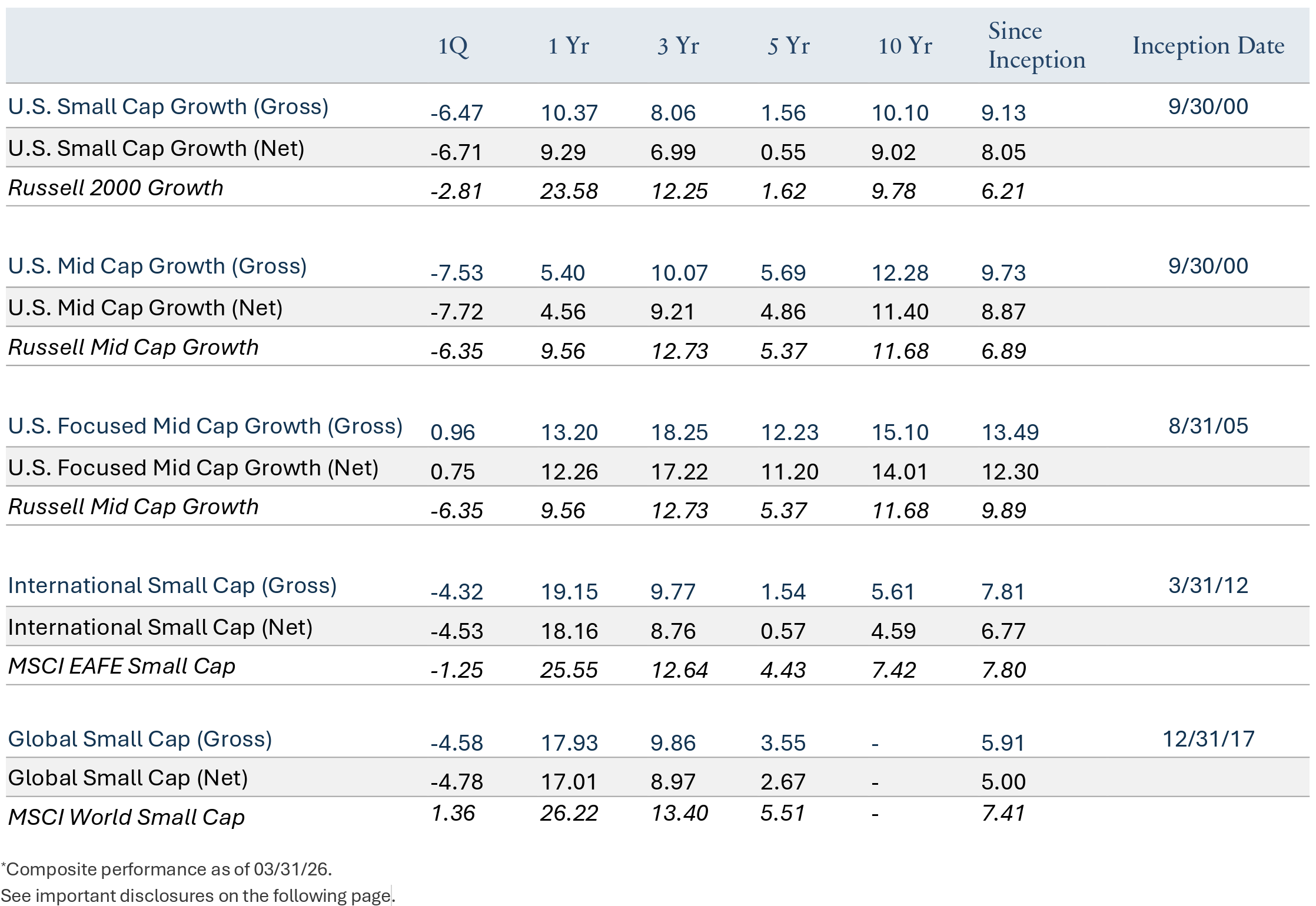
Performance
1 Primoris Services Corporation. (2025, February 24). Primoris Services Corporation reports fourth quarter and full year 2024 results.
2 Melich, G., Montani, M., Wintermantel, O., & Regan, D. (2026, April 13). Energy matters: Higher for longer cuts EPS growth. Evercore ISI.
³ Pollard, M., Moore, E., Sood, V., & Bass, J. (2026, April 7). Western Europe apparel & footwear: Polyester price increases due to higher oil price; we highlight headwinds for fashion and sporting goods names. Citi Research. Additional Source(s): Company commentary, industry conferences, and third-party research.
TimesSquare Capital Management, LLC (“TimesSquare”) is an investment adviser registered with the U.S. Securities and Exchange Commission and is majority owned by Affiliated Managers Group, Inc. It claims compliance with the Global Investment Performance Standards (GIPS®) and is independently verified. A firm that claims compliance with the GIPS standards must establish policies and procedures for complying with all the applicable requirements of the GIPS standards. Verification provides assurance on whether the firm's policies and procedures related to composite and pooled fund maintenance, as well as the calculation, presentation, and distribution of performance, have been designed in compliance with the GIPS standards and have been implemented on a firm-wide basis. Policies for valuing investments, calculating performance, and preparing GIPS Reports are available upon request. GIPS® is a registered trademark of CFA Institute. CFA Institute does not endorse or promote this organization, nor does it warrant the accuracy or quality of the content contained herein.
The opinions and information expressed and provided are for general information only and are not intended to provide specific advice or recommendations but rather, a basis from which strategies can be built, taking into account the specific objectives of each portfolio, in terms of return, time horizon, and risk constraints, as well as diverging investment perspectives and assumptions. All material has been obtained from sources believed to be reliable, but its accuracy and completeness are not guaranteed.
U.S. Small Cap Growth: Performance is measured against the Russell 2000® Growth – a market capitalization-weighted index that measures the performance of those Russell 2000® companies with higher price-to-book ratios and higher forecasted growth rates. All indexes, including the Russell 2000® Growth Index, are based on gross-of-fee returns. FTSE Russell is the source and owner of the Russell Index data contained or reflected in this material and all trademarks and copyrights related thereto. Benchmark returns are not covered by the report of independent verifiers.
U.S. Mid Cap Growth: Performance is measured against the Russell Midcap® Growth – a market capitalization-weighted index that measures the performance of those Russell Midcap® companies with higher price-to-book ratios and higher forecasted growth rates. All indexes, including the Russell Midcap® Growth Index, are based on gross-of-fee returns. FTSE Russell is the source and owner of the Russell Index data contained or reflected in this material and all trademarks and copyrights related thereto. U.S.
Focused Mid Cap Growth: Performance is measured against the Russell Midcap® Growth – a market capitalization-weighted index that measures the performance of those Russell Midcap® companies with higher price-to-book ratios and higher forecasted growth rates. All indexes, including the Russell Midcap® Growth Index, are based on gross-of-fee returns. FTSE Russell is the source and owner of the Russell Index data contained or reflected in this material and all trademarks and copyrights related thereto.
International Small Cap: Performance is measured against the MSCI EAFE Small Cap (Net) Index. MSCI EAFE Small Cap (Net) Index is a trade or service mark of MSCI Inc. The MSCI EAFE Small Cap (Net) Index is an unmanaged, market-weighted index of small companies in developed markets, excluding the U.S. and Canada. Its returns include net reinvested dividends but, unlike the Composite returns shown, do not reflect the payment of sales commissions or other expenses incurred in the purchase or sale of the securities included in the Index. All indexes, including the MSCI EAFE Small Cap (Net) Index, are based on gross-of-fee returns, including net reinvested dividends.
Global Small Cap: Performance is measured against the MSCI World Small Cap (Net) Index. MSCI World Small Cap (Net) Index is a trade or service mark of MSCI Inc. The MSCI World Small Cap (Net) Index is an unmanaged, market-weighted index of small companies in developed markets. Its returns include net reinvested dividends but, unlike the Composite returns shown, do not reflect the payment of sales commissions or other expenses incurred in the purchase or sale of the securities included in the Index. All indexes, including the MSCI World Small Cap (Net) Index, are based on gross-of-fee returns, including net reinvested dividends.
Indices are unmanaged, are unable for direct investment and do not reflect the deduction of fees and expenses.
Past performance does not guarantee future results. There is risk that invested capital may be lost.
(Blue%20%26%20Gold)(Transparent)(2125x844)%20PNG.png)