
TSCM: Inside the Investment Room
DOWNLOAD THE PDFTSCM: Inside the Investment Room is a bulletin offering the Firm’s perspectives on current market developments.
Where Fundamentals Meet Opportunity: Navigating Market Rotation, AI Investment, and Selective Growth
In this edition of Inside the Investment Room, we examine how shifting market leadership, persistent cost pressures, and evolving AI investment trends are creating opportunities across small- and mid cap equities.
From accelerating offshore energy activity and the expansion of AI networking infrastructure to selective opportunities in healthcare, financials, and industrials, the team remains focused on separating durable fundamental growth from near-term market volatility.
Executive Summary
Markets remain highly differentiated as shifting investor sentiment, valuation pressure, and company-specific execution challenges create opportunities across sectors. The team continues to favor durable growth themes, particularly AI infrastructure, offshore energy, and select industrial businesses, while reassessing underperforming holdings and monitoring emerging catalysts. With macro uncertainty persisting, disciplined valuation, fundamental research, and selective positioning remain central to identifying attractive small- and mid-cap opportunities as 2026 winds down and 2027 begins.
Sector Perspectives — Takeaways
Technology
AI infrastructure investment remains a powerful secular growth driver, although intensifying competition, evolving pricing models, and elevated expectations are creating greater differentiation across the technology ecosystem.
- Infrastructure opportunities broaden: Semiconductor equipment and optical networking remain favored areas as AI demand expands beyond computing hardware toward connectivity, memory, and data-center infrastructure.
- AI economics evolve: Growing adoption of open-weight models and spot-priced computing capacity could accelerate usage while introducing greater pricing competition across infrastructure providers.
- Software adoption continues: Enterprise cloud migration and AI-enabled workflows support long-term software demand, although the timing of monetization remains an important consideration for emerging AI products.
Financials
Financials remain sensitive to interest rates and capital-markets activity, with improving transaction pipelines offering potential upside despite valuation compression and uneven investor sentiment.
- Capital-markets recovery: Investment banking pipelines remain healthy, but stronger sponsor activity and larger transaction announcements are needed to translate activity into sustained earnings growth.
- Insurance selectivity: Elevated valuations and competitive pressures are prompting a assessment of certain holdings, while niche specialty insurers with differentiated exposures remain under consideration.
- Trading and brokerage: Online brokerage platforms remain under review, with stronger client activity and margin growth needed to support renewed momentum.
Energy
Improving offshore activity and growing power demand continue to support select energy businesses, while commodity volatility and regional execution risks reinforce the importance of stock selection.
- Offshore recovery strengthens: International drilling, subsea, and maintenance activity are improving across several regions, supporting the potential for a multiyear offshore investment cycle.
- Power infrastructure expands: Behind-the-meter power generation remains an attractive structural opportunity as data-center electricity demand accelerates.
- Commodity sensitivity persists: Oil-price fluctuations and delayed regional activity create near-term volatility, potentially offering opportunities to add to fundamentally attractive businesses.
Industrials & Infrastructure
Industrial demand remains broadly constructive, but rising input costs and execution challenges are creating meaningful dispersion between companies with pricing power and those facing margin pressure.
- Margin pressure intensifies: Tariffs, freight, metals, and other input costs are weighing on profitability despite generally resilient industrial demand.
- Structural growth opportunities: Specialty materials, engineered products, and infrastructure-related businesses remain attractive where pricing improvements and durable demand can support earnings growth.
- Defense funding uncertainty: Budget delays could disproportionately affect emerging defense technology programs, reinforcing a preference for companies with established funding visibility.
Consumer
Consumer trends remain mixed, with macroeconomic pressures weighing on select restaurant and retail businesses despite encouraging company-specific operating indicators.
- Restaurant recovery remains delayed: Promotional activity and improving sales data have yet to translate into a sustained turnaround for select restaurant businesses.
- Delivery platforms show resilience: Customer acquisition, engagement, and expansion into grocery and other categories remain supportive, despite questions surrounding AI-driven competition and regulatory exposure.
- Valuation and timing matter: Select retailers and consumer technology businesses offer longer-term potential, but near-term earnings comparisons, competitive pressures, and elevated valuations warrant patience.
Health Care
Healthcare fundamentals remain largely company-specific, with clinical developments, product launches, and regulatory milestones driving investment opportunities amid uneven sector sentiment.
- Biotech selectivity increases: Clinical setbacks and safety concerns are reinforcing a preference for differentiated pipelines, compelling launches, and manageable development risk.
- Medtech fundamentals remain resilient: Select companies continue to demonstrate improving revenue and profitability despite valuation pressure and regulatory uncertainty.
- Research opportunities expand: Improving biotech funding conditions and stabilizing pharmaceutical budgets are prompting renewed research into contract research organizations and other healthcare service providers.
Key Macro Trends
- Market Rotation & Valuation Discipline: Positioning-driven selloffs and multiple compression are creating opportunities, but strong fundamentals alone may not support near-term share-price recovery.
- AI Infrastructure Evolution: Demand for semiconductor equipment, memory, optical networking, and power infrastructure remains a structural opportunity, although competition, pricing dynamics, and the timing of capital spending could create volatility.
- Persistent Cost Pressures: Tariffs, freight, commodity prices, and other input costs continue to challenge margins across industrial and consumer businesses.
- Capital Markets & M&A: Healthy investment banking pipelines and potential sponsor activity offer recovery opportunities, though higher rates and macro uncertainty remain constraints.
- Looking Toward 2027: Pricing resets, new product cycles, offshore energy investment, and AI infrastructure demand are creating potential catalysts beyond near-term earnings volatility.
The Bottom Line
The investment landscape remains characterized by meaningful divergence between underlying fundamentals and market sentiment. While near-term macro pressures and execution risks warrant caution, structural opportunities across AI infrastructure, energy, healthcare, and select industrial businesses remain compelling. The team continues to emphasize disciplined valuation, company-specific catalysts, and thoughtful portfolio positioning, seeking to capitalize on market dislocations while maintaining a long-term focus on durable earnings growth into 2027.
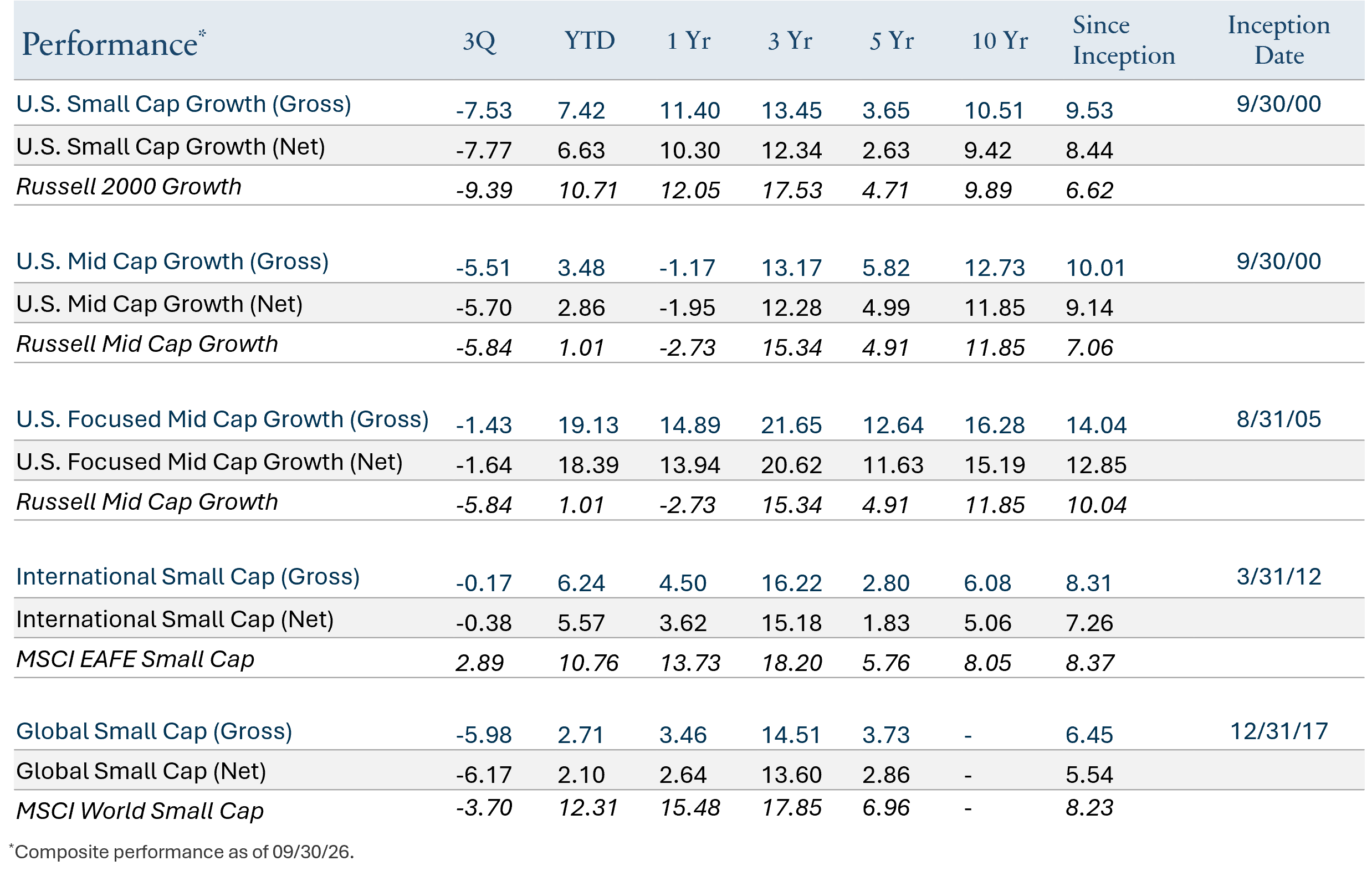
Disclosures
The views expressed are those of the investment team as of September 2026 and are subject to change without notice. The discussion reflects current opinions and market observations and should not be regarded as investment advice or are commendation regarding any security, sector, or investment strategy. There is no assurance that any forecast, outlook, or investment objective will be achieved.
This does not constitute advice or a recommendation or offer to sell or a solicitation to deal in any security or financial product. It is provided for information purposes only and on the understanding that the recipient has sufficient knowledge and experience to be able to understand and make their own evaluation of the proposals and services described herein, any risks associated there with and any related legal, tax, accounting or other material considerations.
Except where otherwise indicated, the information contained in this presentation is based on matters as they exist as of the date of preparation of such material and not asof the date of distribution or any future date. Recipients should not rely on this material in making any future investment decision.
Certain information contained herein constitutes “forward-looking statements,” which can be identified by the use of forward-looking terminology such as “may,” “will,” “should,” “expect,” “anticipate,” “project,” “estimate,” “intend,” “continue,” or “believe,” or the negatives thereof or other variations thereon or comparable terminology. Due to various risks and uncertainties, actual events, results or actual performance may differ materially from those reflected or contemplated in such forward-looking statements. Nothing contained herein maybe relied upon as a guarantee, promise, assurance or a representation as to the future.
TimesSquare Capital Management, LLC (“TimesSquare”) is an investment adviser registered with the U.S. Securities and Exchange Commission and is majority owned by Affiliated Managers Group, Inc. It claims compliance with the Global Investment Performance Standards (GIPS®) and is independently verified. A firm that claims compliance with the GIPS standards must establish policies and procedures for complying with all the applicable requirements of the GIPS standards. Verification provides assurance on whether the firm's policies and procedures related to composite and pooled fund maintenance, as well as the calculation, presentation, and distribution of performance, have been designed in compliance with the GIPS standards and have been implemented on a firm-wide basis. Policies for valuing investments, calculating performance, and preparing GIPS Reports are available upon request. GIPS® is a registered trademark of CFA Institute. CFA Institute does not endorse or promote this organization, nor does it warrant the accuracy or quality content contained herein.
The opinions and information expressed and provided are for general information only and are not intended to provide specific advice or recommendations but rather, a basis from which strategies can be built, taking into account the specific objectives of each portfolio, in terms of return, time horizon, and risk constraints, as well as diverging investment perspectives and assumptions. All material has been obtained from sources believed to be reliable, but its accuracy and completeness are not guaranteed.
U.S. Small Cap Growth: Performance is measured against the Russell 2000® Growth – a market capitalization-weighted index that measures the performance of those Russell 2000® companies with higher price-to-book ratios and higher forecasted growth rates. All indexes, including the Russell 2000® Growth Index, are based on gross-of-fee returns. FTSE Russell is the source and owner of the Russell Index data contained or reflected in this material and all trademarks and copyrights related thereto. Benchmark returns are not covered by the report of independent verifiers.
U.S. Mid Cap Growth: Performance is measured against the Russell Midcap® Growth – a market capitalization-weighted index that measures the performance of those Russell Midcap® companies with higher price-to-book ratios and higher forecasted growth rates. All indexes, including the Russell Midcap® Growth Index, are based on gross-of-fee returns. FTSE Russell is the source and owner of the Russell Index data contained or reflected in this material and all trademarks and copyrights related thereto.
U.S. Focused Mid Cap Growth: Performance is measured against the Russell Midcap® Growth – a market capitalization-weighted index that measures the performance of those Russell Midcap® companies with higher price-to-book ratios and higher forecasted growth rates. All indexes, including the Russell Midcap® Growth Index, are based on gross-of-fee returns. FTSE Russell is the source and owner of the Russell Index data contained or reflected in this material and all trademarks and copyrights related thereto.
International Small Cap: Performance is measured against the MSCI EAFE Small Cap (Net) Index. MSCI EAFE Small Cap (Net) Index is a trade or service mark of MSCI Inc. The MSCI EAFE Small Cap (Net) Index is an unmanaged, market-weighted index of small companies in developed markets, excluding the U.S. and Canada. Its returns include net reinvested dividends but, unlike the Composite returns shown, do not reflect the payment of sales commissions or other expenses incurred in the purchase or sale of the securities included in the Index. All indexes, including the MSCI EAFE Small Cap (Net) Index, are based on gross-of-fee returns, including net reinvested dividends.
Global Small Cap: Performance is measured against the MSCI World Small Cap (Net) Index. MSCI World Small Cap (Net) Index is a trade or service mark of MSCI Inc. The MSCI World Small Cap (Net) Index is an unmanaged, market-weighted index of small companies in developed markets. Its returns include net reinvested dividends but, unlike the Composite returns shown, do not reflect the payment of sales commissions or other expenses incurred in the purchase or sale of the securities included in the Index. All indexes, including the MSCI World Small Cap (Net) Index, are based on gross-of-fee returns, including net reinvested dividends.
Indices are unmanaged, are unable for direct investment and do not reflect the deduction of fees and expenses.
Past performance does not guarantee future results. There is risk that invested capital may be lost.
(Blue%20%26%20Gold)(Transparent)(2125x844)%20PNG.png)